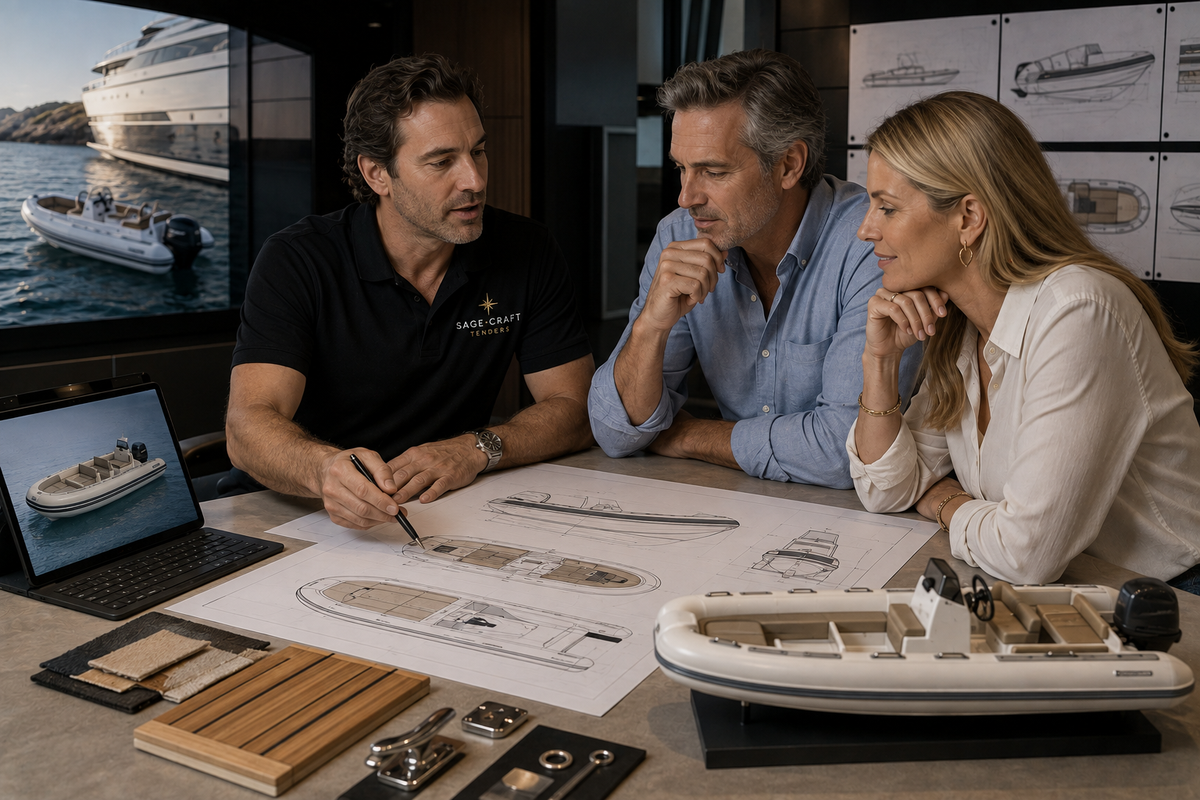
Article: From Timber to Aluminum: The Evolution of the Tender Hull
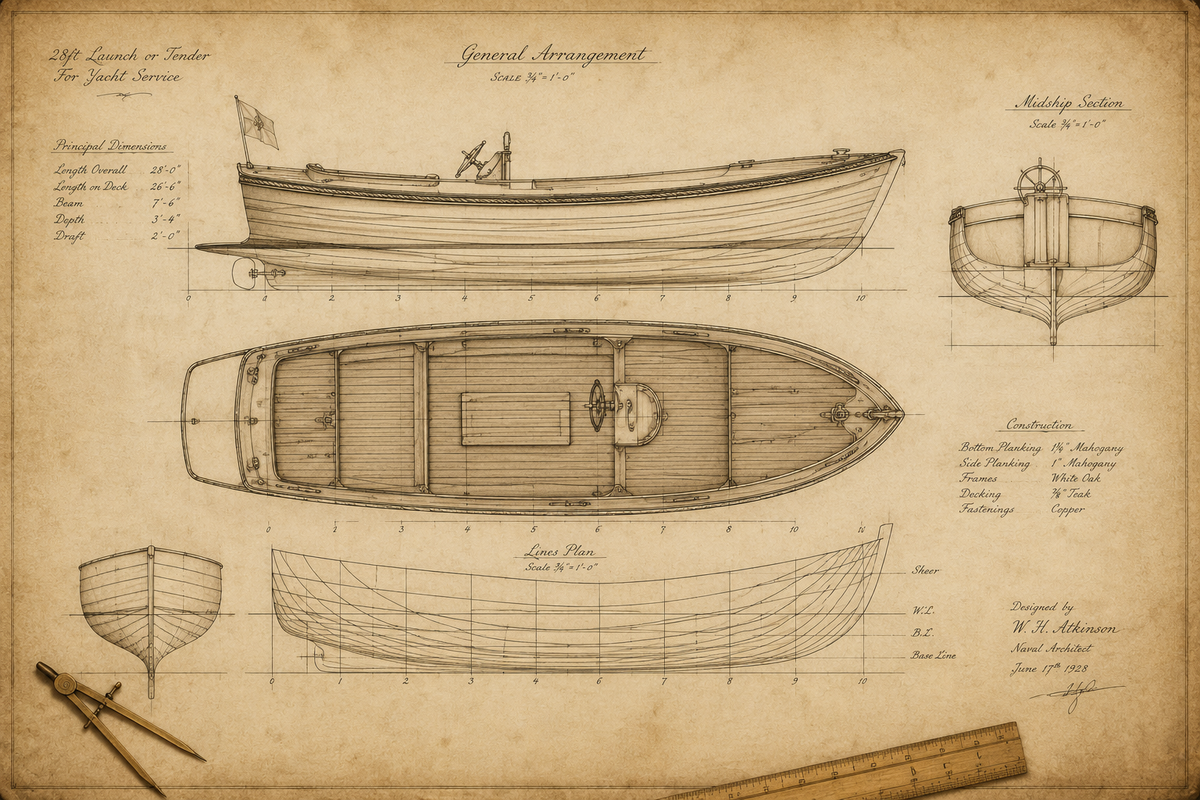
From Timber to Aluminum: The Evolution of the Tender Hull
For centuries, the tender has evolved alongside the yacht it serves. Today's aluminum hull represents another important step in that evolution—one particularly well suited to the way modern yacht owners explore.
Long before there were yacht garages, hydraulic swim platforms or high-horsepower outboards, there was the ship's boat.
It served a remarkably familiar purpose: carry people and provisions between ship and shore, explore waters too shallow for the mothership, and provide a smaller, more maneuverable craft when needed.
The mission hasn't changed much.
The boats certainly have.
The Beginning: Wood
For most of maritime history, the obvious material for building a small boat was wood.
Skilled craftsmen developed increasingly sophisticated methods of constructing hulls around keels and frames, covering them with carefully shaped planking. The result could be strong, beautiful and remarkably seaworthy.
For centuries, this was simply how boats were built.
And wood possessed another quality that remains relevant to luxury yachting today: craftsmanship was visible.
A beautifully constructed launch was more than transportation. Proportion, joinery and finish communicated the skill of its builder and character of its owner.
But wood brought compromises.
It required considerable maintenance. Moisture could lead to rot. Fasteners and seams demanded attention. And building a high-quality wooden boat required enormous amounts of skilled labor.
As yachts evolved, builders began searching for materials that could deliver strength with greater durability.
The Industrial Age: Steel
The 19th century brought a transformation in marine construction.
As steelmaking improved, shipbuilders gradually moved from timber toward metal. By the 1880s, even major naval fleets were transitioning from wooden ships to steel-hulled vessels.
Steel offered enormous structural strength and durability. A metal hull could tolerate impacts that might puncture more brittle construction.
But what worked brilliantly for ships wasn't necessarily ideal for tenders.
Steel is heavy.
For a small craft that needs to accelerate quickly, operate efficiently and—most importantly for yachting—potentially be lifted aboard another vessel, every pound matters.
The next chapter would be considerably lighter.
The Arrival of Aluminum
Aluminum's marine potential was recognized surprisingly early.
It began appearing in experimental vessel construction in the 1890s. America's Cup yacht Defender, launched in 1895, famously incorporated aluminum as builders explored ways to reduce weight. Early experiments also exposed an important problem: the aluminum alloys and construction techniques of the era weren't yet ready for prolonged exposure to the marine environment.
The idea was ahead of the technology.
That changed during the 20th century.
Advances in marine-grade alloys and welding during the 1950s and 1960s transformed aluminum into a practical structural boatbuilding material. Its combination of low weight and strength made it particularly attractive for small and medium-size vessels where performance mattered.
Suddenly, builders could create strong metal boats without accepting the weight penalty traditionally associated with metal construction.
That would prove enormously important.
The Fiberglass Revolution
At roughly the same time, another material was transforming recreational boating: fiberglass.
By the 1960s, fiberglass construction was becoming prevalent in yacht and pleasure-boat production.
It wasn't difficult to understand why.
Fiberglass could be molded into complex shapes. Once a mold was created, builders could reproduce hulls efficiently and consistently. It didn't rot like traditional timber or rust like steel.
For mass-produced recreational boats, it was revolutionary.
Fiberglass remains an excellent hull material today and will continue to have an important place in yacht tender construction.
But the way yacht owners use their tenders has changed.
And that makes aluminum increasingly interesting.
The Modern Tender Has a Different Job
A generation ago, the tender's primary mission might have been summarized simply:
Yacht to shore. Shore to yacht.
Today's owners increasingly expect much more.
A modern tender may spend the morning carrying guests to breakfast ashore, the afternoon exploring shallow coves, beaches and reefs, and the evening traveling several miles to a waterfront restaurant.
It may carry snorkeling equipment, provisions, children, dogs and water toys.
It may be beached.
It may operate around rocky shorelines.
And after doing all of that, it may need to be lifted back onto a yacht.
The tender has evolved from a utility boat into an exploration vehicle.
And that changes what we should ask of its hull.
Why Aluminum Makes So Much Sense
Strength Without Excessive Weight
Perhaps aluminum's greatest advantage is its strength-to-weight relationship.
The Aluminum Association notes that aluminum structures can weigh substantially less than comparable steel structures while providing significant structural strength.
For a yacht tender, lower hull weight can have benefits throughout the entire boat.
Less weight can mean easier launching and retrieval, less demand on lifting equipment, responsive acceleration and the opportunity to allocate weight elsewhere—to fuel, passengers, equipment or other features.
On a tender, weight is a budget.
Saving it in the structure gives the designer more freedom everywhere else.
Built for Real Exploration
There is another characteristic of metal construction that's difficult to quantify on a specification sheet:
Confidence.
The places worth exploring aren't always surrounded by perfect docks.
Sometimes there is a beach.
Sometimes there are rocks.
Sometimes there's an unfamiliar harbor wall, a shallow creek or a coastline you'd simply like to investigate more closely.
A properly engineered aluminum hull can create an exceptionally robust foundation for a tender intended to experience those environments.
That doesn't make it indestructible.
It makes it appropriate for a boat designed to be used.
Marine Alloys Have Come a Long Way
Today's aluminum tender is very different from those experimental aluminum vessels of the 1890s.
Modern marine alloys were specifically developed with properties such as strength, weldability and resistance to marine corrosion in mind. The Aluminum Association, for example, identifies 5083 aluminum as a material used in marine applications.
Modern small-craft standards also explicitly address aluminum alloys alongside steel, wood and other accepted structural materials.
Material selection, welding, isolation of dissimilar metals and electrical design remain important. Aluminum isn't immune to corrosion simply because it's aluminum.
But when properly engineered and constructed, it is an extraordinarily capable marine material.
Aluminum and the Yacht Garage
There is another reason aluminum feels particularly appropriate for today's yachting lifestyle.
The tender increasingly has to fit into the architecture of the mothership.
Garages have defined dimensions. Cranes have safe working loads. Hydraulic platforms have weight limits. Owners want larger engines, more comfortable seating, electronics, sound systems, storage and greater range.
All of those things add weight.
A lighter structural foundation gives designers more room to balance those competing priorities.
The question is no longer simply:
How large a tender can fit?
A better question is:
How much capability can we intelligently fit into the space and weight available?
That is a very different design philosophy.
Durability Is a Form of Luxury
Luxury is often associated with materials that feel delicate.
We see it differently.
On a tender, true luxury is the confidence to use the boat without constantly worrying about it.
It's pulling up to an unfamiliar beach.
Exploring the narrow entrance to a secluded cove.
Taking the long way back to the yacht because the coastline ahead looks interesting.
It's building something beautiful enough to complement the mothership—but capable enough that its owner doesn't hesitate to explore beyond it.
Aluminum lends itself particularly well to that philosophy.
And Then There Is Sustainability
Longevity matters for another reason.
Aluminum is highly recyclable and can be recycled repeatedly without losing its inherent material properties. The Aluminum Association estimates that nearly 75% of all aluminum ever produced remains in use today.
For us, that aligns with a broader philosophy of building products intended to endure.
The most sustainable tender isn't necessarily the one built from the newest material.
It may simply be the one worth maintaining, repairing and keeping for a very long time.
The Next Chapter of an Old Idea
The history of the tender is ultimately a history of adaptation.
Wood gave us craftsmanship and centuries of boatbuilding knowledge.
Steel demonstrated what structural metal could accomplish.
Fiberglass transformed recreational boatbuilding and enabled extraordinary freedom of form.
And modern marine aluminum brings together a compelling combination of strength, lightness, durability and repairability.
There is no single hull material that's objectively right for every boat.
But for the modern yacht tender—one expected to be lightweight enough to live aboard a yacht, refined enough to complement it, and strong enough to encourage genuine exploration—we believe aluminum deserves particular attention.
Because the purpose of a tender has changed.
It's no longer simply the boat that takes you ashore.
It's the boat that takes you farther.
SAGE ✦ CRAFT TENDERS
Built for a Life of Exploration.
Guided by Polaris.